
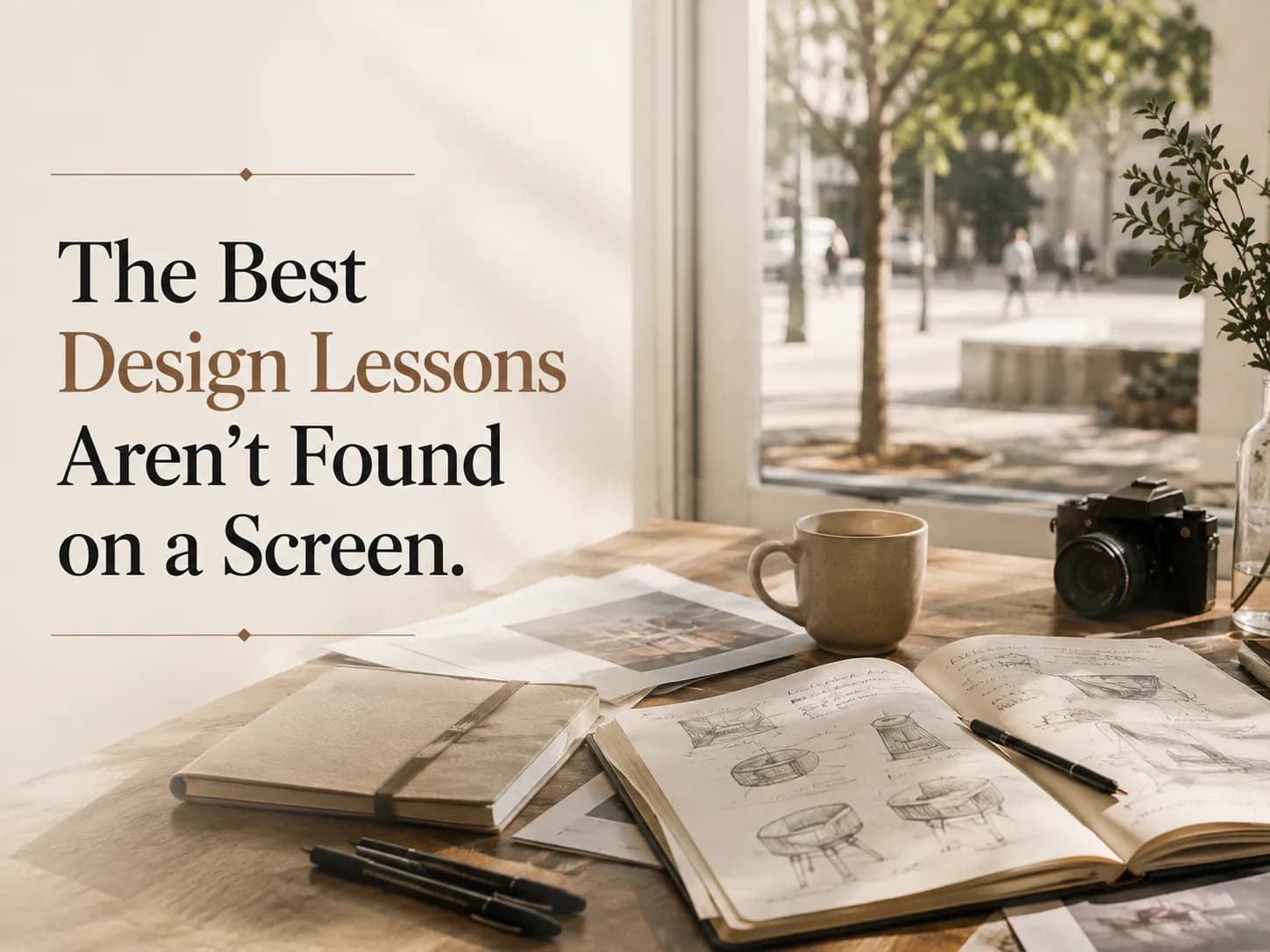
We are surrounded by screens.
We learn from them, communicate through them, search through them and increasingly, create through them. Whenever we want to understand something, our first instinct is often to look it up. Whenever we need an idea, there is now a tool ready to give us one.
It is convenient. It is fast. But somewhere along the way, I think we have started confusing having information with understanding something.
Think about something as ordinary as standing in a crowded railway station. You can read about how people move through public spaces. You can watch videos, study photographs or ask AI to explain the problems people might face there. But being there is different. You notice the person who keeps looking around because they cannot find the right platform. You notice how people behave when they are in a hurry. You notice the noise, the confusion and the small moments that no report could fully capture. You start seeing the problem instead of simply reading about it.
From is where real learning begins. We often talk about understanding people, but understanding is not something that can always be achieved by collecting more information. Sometimes you need to observe. Sometimes you need to listen. Sometimes you need to experience the situation yourself. But there is an important catch: experience alone doesn't automatically make us right.
Our own experiences can also create assumptions. We might think, “I faced this problem, so I know exactly how everyone else feels.” We don't.
Perhaps the real lesson is not simply to experience more, but to experience, observe and question ourselves at the same time, This becomes even more interesting in the age of AI. AI can give us explanations, possibilities and answers within seconds. It can help us explore things we might never have encountered on our own. I don't think that is something we should fear.
Imagine using AI not as something that finishes your thinking, but as something that challenges it. Instead of saying, “Here is the answer,” it could say, “Here is one possibility. Now go look around. Find something that proves it wrong.”
That would make technology a reason to explore the world, rather than a replacement for it. Because the best learning doesn't always happen when someone gives us the right answer. Sometimes it happens when we discover that our first answer was wrong.
A failed attempt. An unexpected conversation. A confusing situation. A small observation that nobody else noticed.
These moments become part of how we think. And perhaps that is what we should protect as technology becomes more capable: not our ability to produce things, but our ability to notice, question and care about what we are producing in the first place.
The screen can give us information. It can give us possibilities. It can even give us answers.
But the world gives us something harder to automate: experience. So perhaps the best lesson isn't to choose between technology and the real world.
It is to know when to use the screen—and when to put it down.
Because sometimes, the most valuable thing a curious person can do is simply look around.